About
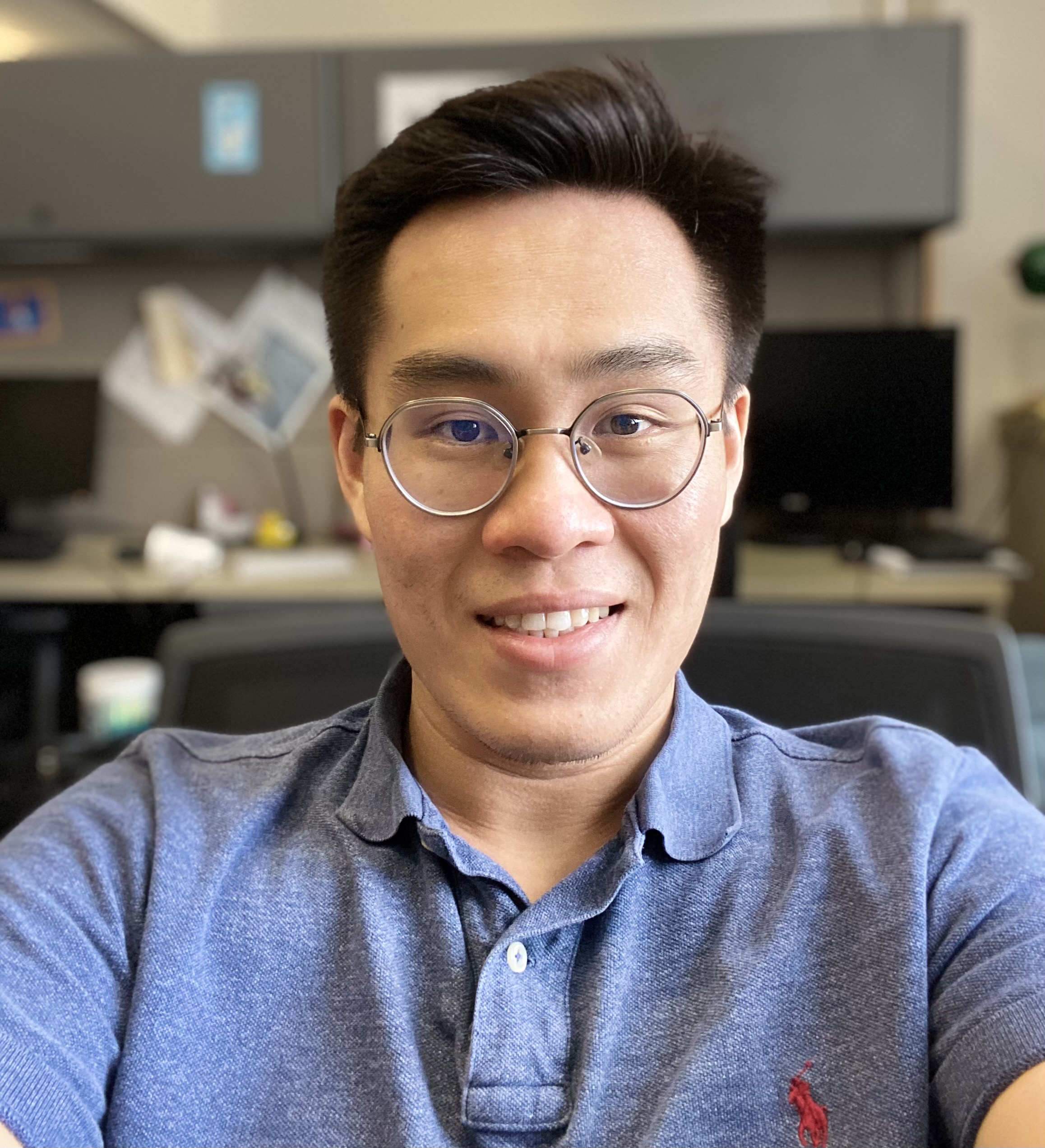
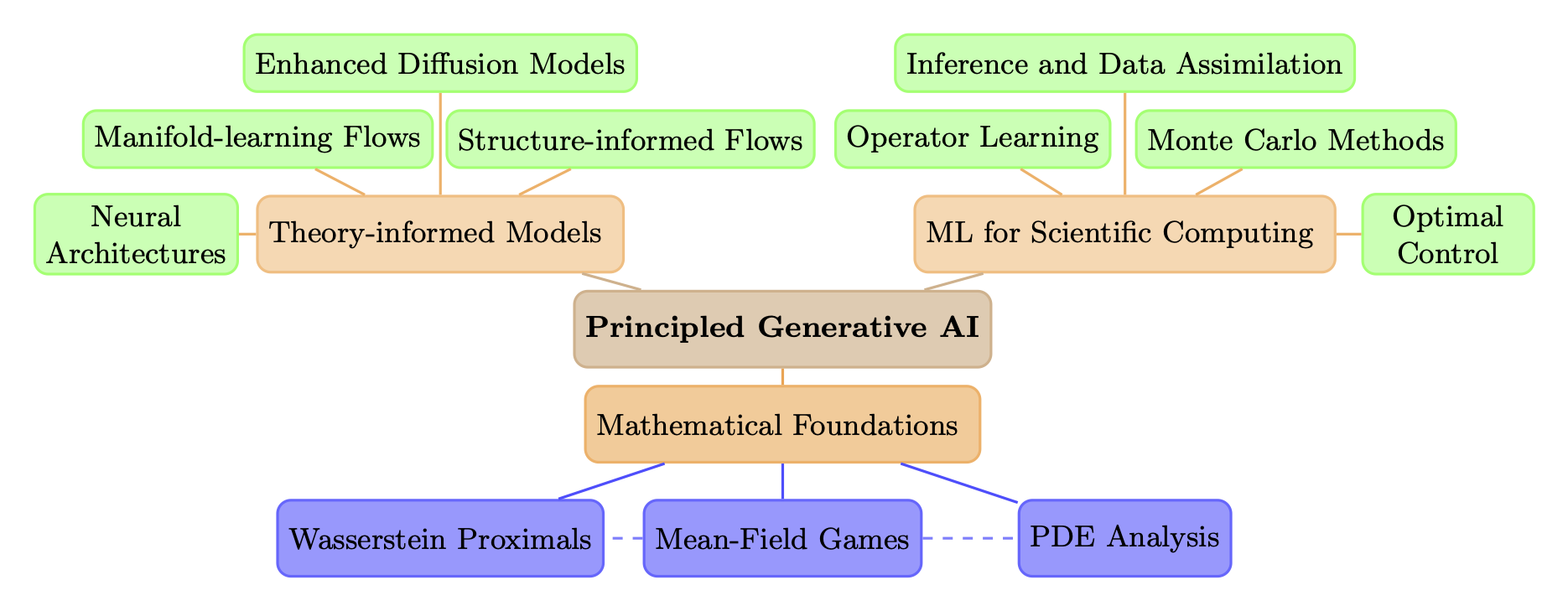
I am an Assistant Professor in the Department of Mathematics at Rutgers University. I am an applied and computational mathematician. My research interests lie broadly at the intersection of generative machine learning, mathematical control theory, and Bayesian computation.
Prior to joining Rutgers, I held postdoctoral appointments in the School of Data Science and Society at UNC Chapel Hill, the Division of Applied Mathematics at Brown University, and the Department of Mathematics and Statistics at UMass Amherst.
I earned my PhD in Computational Science and Engineering and SM in Aeronautics & Astronautics at MIT. My advisor was Youssef Marzouk who heads the Uncertainty Quantification group. I received my Bachelor’s degrees in Engineering Physics and Applied Mathematics at UC Berkeley.
Recent News
February
Our paper Wasserstein proximal operators describe score-based generative models and resolve memorization has been accepted to the SIAM Journal on Mathematics of Data Science!
November
New preprint on Knothe-Rosenblatt maps (triangular maps) and optimal transport: In Knothe-Rosenblatt maps via soft-constrained optimal transport, we show that the KR map can be obtained as a limit of maps solving a relaxed optimal transport problem with a soft optimal transport constraint. Our results provide theoretical jusification for variational methods that estimate KR maps by minimizing a divergence and provides new methodological ideas for new ways of constructing these maps. This is joint work with Ricardo Baptista, Franca Hoffman, and Minh Nguyen.
October
New preprint on transformer architectures: In Stability of Transformers under Layer Normalization, we study how layer normalization placement affects the stability of transformers, analyzing both the growth of hidden states and the backpropagation of gradients. Our theory explains when different placements lead to stable training and guides the scaling of residual connections for improved performance. This is joint work with Kelvin Kan, Xingjian Li, Tuhin Sahai, Stan Osher, and Markos Katsoulakis.
Recent and upcoming events
June
Scientific Computing and Differential Equations (SciCADE 2026), June 29 - July 3, 2026.
SIAM Conference on Optimization, June 2-5, 2026.
April
Data Science and Statistics Seminar, Department of Mathematics, University of Tennessee, Knoxville. April 9, 2026.
March
SIAM Conference on Uncertainty Quantification, March 22-25, 2026.
Computational and Applied Mathematics Seminar, School of Mathematical and Statistical Sciences, Arizona State University, March 16, 2026.
Level Set Collective Seminar, Department of Mathematics, UCLA, March 9, 2026.